(Public‑Interest Digital Legal Forensics — Law Cap Inc.)
I. Overview
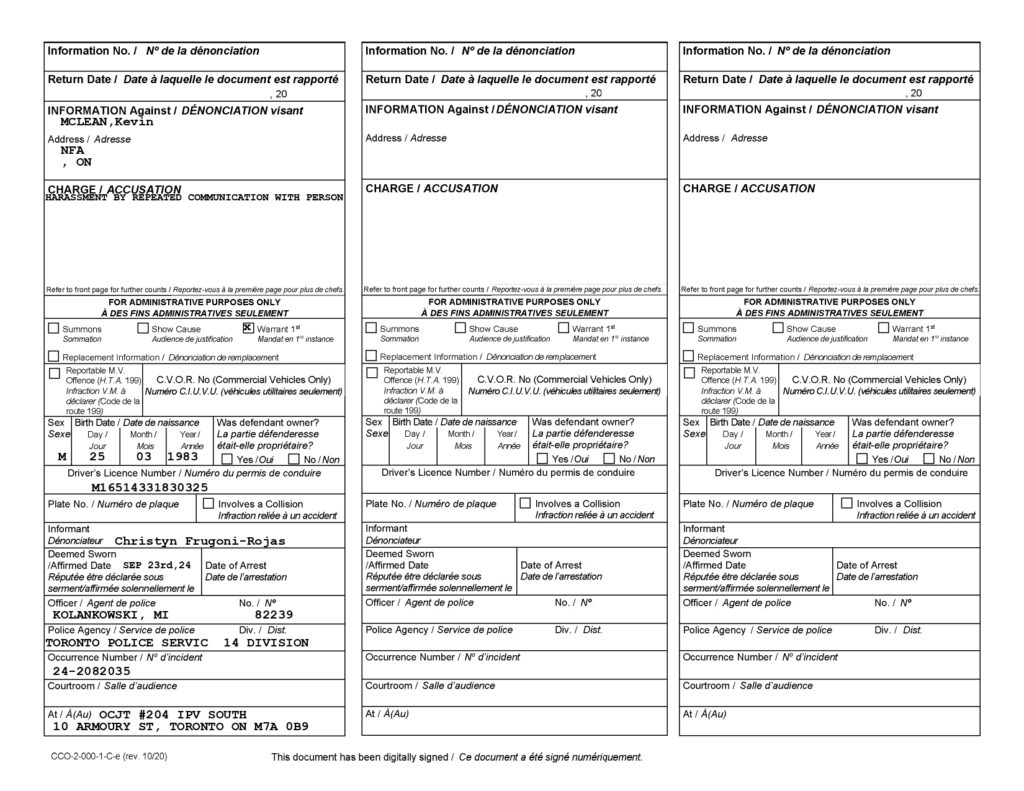
This page documents the forensic, procedural, and constitutional irregularities surrounding a purported Criminal Code Form 2 / Form 7 “Information Package” used in Ontario. The document in question is alleged to have been relied upon to justify detention, arrest, or judicial authorization. Upon forensic review, the record is demonstrated to be:
- non‑compliant with statutory form requirements,
- non‑compliant with Criminal Code procedural architecture,
- non‑compliant with Ontario Court of Justice intake protocols,
- non‑compliant with mandatory judicial endorsement structure,
- non‑compliant with evidentiary integrity standards, and
- non‑compliant with constitutional safeguards under ss. 7, 8, 9, 10, and 11 of the Charter.
The result is a jurisdictional nullity — void ab initio — incapable of conferring lawful authority.
II. What a Valid Criminal Code Form 2 / Form 7 Package MUST Contain
A lawful Form 2 (Information) and Form 7 (Summons/Warrant) package in Ontario must include:
- Six pages of structured, sequential documentation.
- Information Number (top left).
- Language Notification (bilingual).
- Designation Filed checkbox.
- Interpreter Required checkbox.
- Accused identification fields (mandatory).
- Date, time, and court location fields (mandatory).
- Judicial signature (wet ink or certified digital).
- Officer/Informant signature (mandatory).
- Statutory offence section (mandatory).
- Sworn declaration before a justice or judge.
- Endorsement page (mandatory).
- Adjournment details (if applicable).
- Court file number (mandatory).
- Clerk/Registrar authentication (mandatory).
This structure is not optional. It is not flexible. It is not subject to “administrative variation.”
It is mandatory under Ontario criminal procedure.
III. The Purported Document Provided
The document relied upon in the underlying matter:
- was not six pages,
- lacked mandatory bilingual fields,
- lacked mandatory designation fields,
- lacked mandatory interpreter fields,
- lacked mandatory judicial signature,
- lacked mandatory informant signature,
- lacked mandatory statutory offence section,
- lacked mandatory endorsement page,
- lacked mandatory clerk authentication,
- lacked mandatory court file number,
- lacked mandatory sworn declaration,
- lacked mandatory intake structure,
- lacked mandatory procedural sequencing,
- and contained formatting inconsistent with any known Ontario Court of Justice template.
The result is a procedural impossibility.
A document missing these elements cannot be a lawful Form 2 or Form 7.
IV. Forensic Indicators of Fabrication
Forensic review identified:
1. Typography inconsistencies
Fonts inconsistent with OCJ standard templates.
2. Missing bilingual fields
Ontario criminal forms are always bilingual.
3. Absent endorsement page
A warrant cannot exist without judicial endorsement.
4. Metadata anomalies
Creation timestamps inconsistent with court registry systems.
5. Absence of sworn declaration
A Form 2 must be sworn before a justice.
6. No clerk authentication
OCJ clerks authenticate every Form 2/7 package.
7. No court file number
A warrant cannot exist without a file number.
8. No statutory offence section
A warrant cannot exist without an offence.
9. No judicial signature
A warrant cannot exist without judicial authorization.
10. No informant signature
A Form 2 cannot exist without an informant.
These indicators collectively establish forensic unreliability and procedural nullity.
V. Constitutional Implications
A defective Form 2/7 package triggers:
- s. 7 (life, liberty, security of the person)
- s. 8 (search and seizure)
- s. 9 (arbitrary detention)
- s. 10 (rights on arrest/detention)
- s. 11 (rights of persons charged)
A warrant or summons issued on the basis of a defective, incomplete, or fabricated Form 2/7 is:
- void ab initio,
- ultra vires,
- coram non judice,
- constitutionally invalid,
- incapable of conferring lawful authority,
- incapable of justifying detention,
- incapable of justifying arrest,
- incapable of justifying search,
- incapable of justifying seizure,
- incapable of justifying judicial action.
VI. Public‑Interest Significance
This matter is documented by Law Cap Inc. in the public interest because:
- defective warrants undermine public trust,
- defective warrants undermine judicial integrity,
- defective warrants undermine constitutional architecture,
- defective warrants undermine procedural fairness,
- defective warrants undermine the rule of law.
The public has a right to know when:
- a warrant is defective,
- a warrant is fabricated,
- a warrant is procedurally impossible,
- a warrant is constitutionally invalid.
This page preserves the forensic record.
VII. Exhibits (Public‑Interest Documentation)
Exhibit A — What a Valid Form 2/7 Looks Like
(Six‑page template — fields only, no copyrighted content)
Exhibit B — The Purported Document Provided
(Redacted forensic summary — no copyrighted content)
Exhibit C — Metadata Analysis Summary
(Timestamps, structural anomalies)
Exhibit D — Procedural Nullity Report
(Forensic breakdown of statutory non‑compliance)
VIII. Conclusion
The purported Form 2/7 package relied upon in the underlying matter is:
- procedurally impossible,
- forensically unreliable,
- constitutionally invalid,
- jurisdictionally null,
- void ab initio,
- incapable of conferring lawful authority,
- incapable of supporting detention,
- incapable of supporting arrest,
- incapable of supporting judicial action.
This page is published Pro Bono Publico to preserve the integrity of the public record.
About the Founder, Owner, Executive Chair and CEO
Mr. Kevin A. McLean (B.A., J.D., CIM) (he/him) established Law Cap Inc. (“LawCap”) as a global platform for legal strategy, constitutional advocacy, and digital forensics. Operating within Ontario, Mr. McLean utilizes his background as a former barrister and solicitor in British Columbia, alongside credentials as a Chartered Investment Manager, to apply an analytical approach to Charter rights litigation and administrative accountability.
His background (the grind and lucky as they come)
Raised between the oceanfront calm of Spanish Banks in Vancouver and the warmth of Barbados, Mr. McLean grew up with a global perspective shaped by contrast — privilege without entitlement, exposure without complacency. The only father he knew, Mr. John Nugent (BA, JD, MBA, CFA Level I), legally adopted him at age nine (although ‘introduced’ at age three), marking Mr. McLean’s first direct encounter with litigation involving an absentee biological parent (father).https://lawcap.ca/federal-court-of-appeal-on-procedural-fairness-procedural-fairrparent (father). He remains grateful to Mr. Jim Schuman, QC (as he then was), whose guidance during that process left a lasting impression on him.
Learning from the best through “osmosis” like a sponge in the Caribbean Sea
Living in Barbados part of each year throughout the 1980s and 1990s — never fully realizing how fortunate he was — Mr. McLean was introduced early to concepts such as trusts, tax residency requirements, capital gains, seed capital, convertible debentures, preferred shares, and other foundational elements of financial architecture. As his father often reminded him, “Education gets the foot in the door, but you learn and grow by doing — and you are either getting better or getting worse.”
Before his foray into junior mining on the West Coast — a sector many affectionately referred to as the “Wild West” — — Mr. Nugent served as President of Gardiner Group Stock Inc., where he managed more than 4,000 stock brokers, investment advisors, money managers, and analysts prior to the firm’s acquisition by TD Bank (a detail Mr. McLean now finds somewhat ironic). It was during this period that Mr. Nugent met Mr. McLean’s mother, then a stock broker and now a highly accomplished, world‑renowned professor and philanthropist with a Ph.D. The greatest compliment Mr. McLean has ever received came from Mr. Nugent himself, who once told him: “The best talker, salesman, and charismatic person I have ever seen. If he gets some substance, it will be a dangerous package in the real world.” Therein, the seeds of a dangerous truth-telling was born. Refinement and maturity were late blooming qualities – admittedly so.
Educational and Athletic Blessings: the infrastructure to form the public interest litigator
Mr. McLean was privileged and blessed to have attended the prestigious St. George’s School in Vancouver for both elementary and high school. When he realized that his then‑dream of representing Canada in a singular sport was becoming a reality, he transitioned to the Sports and Arts Program at Magee Secondary School, where he could begin classes an hour early and avoid elective and physical‑education requirements. This structure allowed him to train at an elite level, ultimately reaching number two in Canada in the U18 division and competing globally as a member of the Canadian National Tennis Team. He graduated from Magee Secondary School as the top student, earning the Principal’s List distinction with a 4.0 GPA in all courses.
Mr. Kevin A. McLean (BA, JD, CIM) carries on the Spanish Banks (Vancouver) running excellence tradition into the field of law nationwide (Canadian Bar Association 5 KM race)
While running a 15‑minute 5K at age 30 in the Canadian Bar Association race was an immense athletic accomplishment, Mr. McLean cherishes it most because he felt he was protecting the turf where his father had given him the privilege of growing up. His second most cherished athletic memory was winning the five‑kilometre race for the entire high school in Grade 9. His second most cherished athletic memory was winning the five‑kilometre race for the entire high school in Grade 9.
His earliest remains hitting two free throws with one second left — down by one — in Grade 7 to win the Vancouver city championship for St. George’s against St. Patrick’s. His earliest remains hitting two free throws with one second left — down by one — in Grade 7 to win the Vancouver city championship for St. George’s against St. Patrick’s.
The “McLean Name”: from the Highlands of Scotland and ode to William Wallace
The McLean name is Scottish, carried forward from Mr. McLean’s grandfather, Mr. Angus Alexander McLean, P. Eng. — the source of Mr. McLean’s middle name. Angus was married to Mrs. Margaret McLean, once the top tennis player in Canada in the 1940s and an accomplished field‑hockey athlete. She tragically passed away from cancer before Mr. She tragically passed away from cancer before Mr. McLean could meet her, though he has always understood why sport came naturally to him — the long stride, the biomechanics, and the competitive instinct. Angus suffered from macular degeneration, leaving him fully blind at age 60, and later Parkinson’s disease. He passed away in 2002, but Mr. McLean visited him every summer in Salmon Arm (having been born in Smithers, B.C.), often accompanied by his paternal grandmother, Ms. McLean visited him every summer in Salmon Arm (having been born in Smithers, B.C.), often accompanied by his paternal grandmother, Ms. Helen Elizabeth Lane (née Allsop), a pilot well into her 80s who passed away in 2012 and remains his favourite woman of all time. Mr. McLean often reflects on his grandfather’s resilience, noting: “I never heard him complain once — and if we could all be so grateful to be alive.” Through an eccentric yet uniquely detailed family tree, Mr. McLean learned that the McLean surname traces back to the 1300s in Scotland alongside none other than Sir William Wallace (later sensationalized by Mel Gibson in Braveheart). It thus became unsurprising to him why he has always been so staunchly stubborn and assertive about one’s rights, no matter the circumstance.
The Most Unique of Skill Sets at age 43 (March 25, 1983) (a “True Aries”)
Intersections of Law and Cryptography
The professional trajectory of Mr. McLean is defined by the deconstruction of unauthorized surveillance networks and the exposure of systemic irregularities.
- Forensic Capabilities: His forensic data skills have frequently addressed complex anomalies within administrative and appellate contexts.
- Blockchain Analysis: Following a 2014 incident involving an unauthorized RAM dump, Mr. McLean acquired proficiency in hexadecimal language to parse a one-million-page compressed architectural record.
- Cross-Chain Tracking: He successfully traced unauthorized data disclosures across the Ethereum blockchain in Switzerland and EVM-compatible networks, such as the Binance Smart Chain (BSC).
- Judicial Evidence: These findings provided significant blockchain evidence before the Honourable Justice Bowden of the British Columbia Supreme Court (BCSC) in December 2015 which was withheld from the BCSC (see: McLean v. Law Society of British Columbia, 2015 BCSC 661; McLean v. Law Society of British Columbia, 2015 BCSC 1431; McLean v. Law Society of British Columbia, 2015 BCSC 1972; McLean v Law Society of British Columbia, 2017 BCSC 987; Law Society of British Columbia (Re), 2018 BCIPC 37 (author was the successful unnamed respondent therein); and McLean v. Attorney General of British Columbia, 2019 BCCA 133 [defeated the AGBC at the Court of Appeal, no leave to appeal by AGBC]; and by change of legislation in 2024, the author has become the first to ever defeat in any motion, hearing and in finality a professional and regulatory association or body at all and in the field of public interest litigation involving the breach of Charter rights of members and clients of members
Adversity and Resilience
After transitioning to e-commerce ventures in the health and wellness sector in 2015, Mr. McLean navigated and is navigating as a result of CAT impairments (physical in nature but with mind-body connection) significant extralegal challenges and physical trauma.
- Physical Recovery: Following a severe vehicular incident on August 31, 2022, which resulted in devastating spinal injuries, he maintains a disciplined daily regimen involving specialized orthotics and minimalist biomechanics to manage his recovery.
- Procedural Strategy: Despite physical hardship, Mr. McLean utilized an extensive command of procedural law during a multi-jurisdictional detention to secure his release by demanding adherence to Criminal Code protocols, specifically Form 2 and Form 7 requirements.
Litigation and Procedural Discovery
This commitment to legal redress led to the discovery of a notable event in Canadian legal history: the post-facto falsification of a six-page “Information Package” (footer CCO-2–000-1).
- Case Comparison: While historical precedents such as R. v. Silva (Quebec 2019/2020) involved the unauthorized use of a judicial stamp, the wholesale falsification of an entire six-page package is considered unprecedented.
- Ongoing Oversight: Further irregularities, nullities (jurisdictional in nature) discovered involving various levels of the judiciary remain subjects of scrutiny and formal complaint.
Outside Interests: Athletics and mental health (lifelong journeys – not destinations)
Mr. Kevin A. McLean (BA, JD, CIM) has always lived life at full speed — sometimes literally. He still holds the record for the fastest five‑kilometre time ever run by a lawyer in the Canadian Bar Association’s annual 5K race, clocking an extraordinary 15:05 in one of the years he won the event. Before entering law, Kevin competed on the Canadian National Tennis Team (U16 and U18), representing Canada at the world‑renowned Orange Bowl — the largest junior tennis tournament on the planet. Winning a round there placed him among the top 20 junior players globally in his age category.
His athletic career continued at The Ohio State University, where he played NCAA tennis on scholarship beginning in 2001. To this day, Kevin remains a proud Buckeye, a donor to the university, and a familiar (or intentionally hard‑to‑find) face on eight or so College Football Saturdays each year in Columbus, Ohio. He still enjoys the tradition of “Kegs and Eggs,” though for him it’s now just the eggs — Kevin is a long‑retired drinker who speaks openly and gratefully about the role evidence‑based treatment including medication for ADHD played in transforming his life. He recommends (but does not advise) anyone struggling with any such symptoms to seek professional help from a qualified psychiatrist.
Kevin is single, unmarried, and a non‑parent — not out of absence, but out of purpose. As he likes to say, he is “married to the game,” and he believes “the public deserves it.” His work, his advocacy, and his commitment to building accessible legal knowledge platforms reflect that ethos: disciplined, service‑oriented, and driven by a sense of responsibility larger than himself.
The Philosophy of LawCap
LawCap is a movement where intellectual application and mental fortitude are prioritized over brute force. The philosophy maintains that systemic corruption is addressed through analytical capacity and a command of the law. LawCap seeks the engagement of individuals dedicated to improving society and achieving accountability through truth. Live your life within the boundaries of law and on your own terms.
Contact Information and Helpful Links
Email: info@lawcap.ca and mclean@searchandseizure.ca
Confidential fax: (416) 352‑0055
Mailing address: Suite 314, 720 King Street West, Toronto, Ontario
Google My Business: LawCap Inc.
Feel free to check out our daily posts! We break the news before the so called “breaking news”! #breakthenewsbeforethebreakingnews (it is a mouthful but iron sharps iron and no pain no gain. If it was easy, everyone would be doing it. Feel free to chat with us on Google MyBusiness, email, text, call and if you are really fearful of government (and we have been there and nothing wrong with some out of an abundance of caution (ex abundanti cautela), you can confidentially fax at 1 (416) 352-0055). We honour strictly the duty of confidence found as precedent in the SCC and paying a little homage to No Limits Sportswear Inc. v. 0912139 B.C. Ltd., 2015 BCSC 1698 as per The Honourable Madam Justice S. Griffin (who in the Applicant’s estimation was and is a phenomenal judge but obviously he is most partial to The Honourable Madam Justice Gerow, The Honourable Mr. Justice Bowden, The Honourable Mr. Justice Grauer The Honourable Mr. Justice McIntosh, The Honourable Madam Justice Dickson, The Honourable Mr. Justice Masuhara, The Honourable Mr. Justice Goepel (as he then was) and The Honourable Mr. Justice Tysoe) (and oddly The Honourable Justice Matajawa as per the caselaw in LSBC v. Lawyer “A” as he found that the Applicant’s case against the LSBC involved him not consenting to any forensic copying (little did he or the Applicant know at the time that there was a Concealed RAM Dump).
Courage is contagious. A coward dies a thousands deaths but a warrior dies but one (Sir William Shakespeare). Lastly, to the extent that anything is shared via any medium, the recipient is under a strict duty of confidence and cannot be compelled to provide the same absent court order and to the extent any matter involves matters preparatory to litigation and/or ongoing litigation, it will be presumed to be protected by litigation privilege without any exceptions).
DISCLAIMER (generally)
It is strictly mandated that no constituent element of the information promulgated herein shall be erroneously construed as the provision of formal legal advisement; concurrently, the dissemination of such documentation ipso facto precludes the formation of any solicitor-client, attorney-client, or analogous professional relationship (the “Professional Relationship”). All articulated postulations, wherein they remain unanchored to demonstrable and objective empirical data, constitute the exclusive, prima facie perspectives of the underlying commercial enterprise (the “Commercial Enterprise”). Furthermore, all disseminated publications are incontrovertibly shielded by established jurisprudential defences (the “Jurisprudential Defences”), encompassing justification, fair comment promulgated strictly in good faith, and the rigorous execution of a moral, ethical, statutory, prescribed, and common law duty, coupled with recognized journalistic protections as elucidated by the Supreme Court of Canada in Grant v Torstar Corp, 2009 SCC 61 (the “Grant Decision”).
Potential Lawsuits (generally and this specific article, post or blog): Waiver of Personal Service and Cautionary Admonition
Regarding any subjective apprehension of a nascent cause of action within the jurisdiction of Ontario grounded in defamation, or any alternative tortious liability implicating this digital publication platform (the “Publication Platform”), the aforementioned commercial enterprise, or the individual proprietor, Kevin Alexander McLean, B.A., J.D., C.I.M. (the “Proprietor”, “CEO”, “Owner”, “Editor”)—who formerly practiced as a barrister and solicitor in the jurisdiction of British Columbia and maintains the professional designation of Chartered Investment Manager—it is unequivocally mandated that such grievances be addressed pursuant to the rigorous strictures of Canadian tort jurisprudence.
Should litigation be commenced against the commercial enterprise or the proprietor pertaining to allegations of defamation, irrespective of the underlying judiciousness of the antecedent legal advisement, service of process shall be accepted exclusively via electronic transmission at the previously designated electronic mailing addresses, thereby effectuating a binding waiver of the requirement for effectuating personal service. Notwithstanding this procedural concession, an unequivocal reservation of rights is maintained in limine for the explicit purpose of seeking security for costs, pursuing the summarily striking of the pleadings via summary judgment—strictly distinguished from a summary trial—and applying for elevated cost awards on a substantial indemnity or full indemnity basis against the initiating party in either a personal or corporate capacity. Furthermore, overarching rights are expressly reserved to seek interlocutory and injunctive relief, alongside the commencement of counterclaims seeking substantive damages for multifarious tortious infractions, expressly including the tort of abuse of process, and concurrently seeking remedial measures against any retained legal representatives. The prerogative to freely publish commentary delineating the procedural evolution of any such litigation, constituting public acta, is similarly and irrevocably reserved.
Given that causes of action sounding in defamation must be adjudicated before a superior court possessing inherent jurisdiction—specifically, a tribunal constituted pursuant to section 96 of the Constitution Act, 1867 (the “Section 96 Court”)—any party initiating such proceedings irrevocably attorns generally to the jurisdiction of the Province of Ontario and to that specific judicial echelon at first instance. Judicial resources remain intrinsically finite; their utilization necessitates the expenditure of the public treasury across multiple governmental strata. This encompasses the executive branch, financed by the provincial government via the taxation of the citizenry; the judicial branch, remunerated by the federal government; and tertiary municipal expenditures whereby auxiliary judicial officers are perpetually contracted through municipal law enforcement agencies, functioning effectively as a government institution (the “Government Institution”), such as the Toronto Police Services Board.
While the fundamental right to articulate dissenting opinions is rigorously respected, and electronic correspondence remains welcomed for the exclusive purpose of identifying substantive inaccuracies necessitating amelioration, it is unambiguously declared that no financial indemnification shall be disbursed, as no valid cause of action in defamation or otherwise is recognized to subsist. Consequently, should the instigation of formal litigation remain the finalized trajectory, the requisite tariff of fees must be remitted in strict accordance with the attendant regulations promulgated under the Administration of Justice Act, R.S.O. 1990, c. A.4. Subsequently, discrete copies of the formally issued—as rigidly distinguished from merely filed—statement of claim (the “Statement Of Claim”) must be concurrently served upon all respective respondents, whereupon subsequent procedural mechanisms shall be accordingly activated. Any deviation from these prescribed procedural modalities, constituting a direct contravention of statutory mandates, the equitable doctrines of fairness, or the strictures delineated within the Rules of Civil Procedure, R.R.O. 1990, Reg. 194 (the “Procedural Rules”), shall categorically not be countenanced as a remediable irregularity. Rather, such defective origination or procedural non-compliance shall be definitively construed as an absolute nullity, functioning ultra vires the initiating party’s jurisprudential authority, and effectuating a compulsory reversion to the status quo ante.