Demanding a Franks Hearing: Evidentiary Veracity Challenges, Material Omissions, and the Annihilation of Probable Cause in Federal Wiretap Affidavits (Part 5 of 6)
Opening Question
When a federal law enforcement agent manufactures probable cause or statutory necessity by embedding deliberate falsehoods or reckless material omissions in a Title III wiretap affidavit, what exact preliminary showing must the defense tender to shatter the presumption of affidavit validity, compel an evidentiary Franks hearing, and secure the total suppression of electronic surveillance?
Direct Answer Paragraph
The inclusion of deceptive assertions in a Title III wiretap affidavit affords absolutely no evidentiary preservation. Relying upon Herbert Broom’s equitable maxim fraus omnia corrumpit (fraud vitiates everything), federal courts dictate that proving intentional falsehoods or reckless omissions obliterates the presumption of affidavit validity, rendering resultant wiretap intercepts absolute constitutional nullities.
Overview
In federal criminal litigation, challenging a Title III wiretap warrant on its face—arguing that the four corners of the affidavit fail to show probable cause—is rarely successful. Federal agents spend months assembling exhaustive, multi-hundred-page affidavits detailing complex conspiracies, historical arrests, and confidential informant debriefings. Consequently, reviewing magistrate and district judges grant great deference to the initial warrant determination (Illinois v. Gates, 462 U.S. 213 (1983)).
However, an entirely different, lethal constitutional battleground emerges when the defense launches a sub-surface veracity attack: proving that the factual narrative presented to the issuing judge was built upon deliberate falsehoods, fabricated informant statements, or calculated material omissions.
The governing constitutional framework for challenging warrant veracity was established by the Supreme Court of the United States in the landmark decision Franks v. Delaware, 438 U.S. 154 (1978). Under Franks, an affidavit supporting a warrant enjoys an initial presumption of validity. To pierce this presumption and compel a formal evidentiary hearing (the “Franks Hearing”), the defense bears a formidable initial burden. Defense counsel must make a substantial preliminary showing that:
- The affiant included a false statement in the warrant affidavit, or omitted material facts;
- The affiant made the false statement knowingly and intentionally, or with reckless disregard for the truth; and
- The allegedly false statement or omitted fact was material—meaning that with the affidavit’s false material set to one side (or the omitted facts added), the affidavit’s remaining content is insufficient to establish probable cause.
In the context of Title III wiretaps, the Franks doctrine takes on an expanded, dual-pronged dimension. A federal wiretap affidavit must establish not only traditional Fourth Amendment probable cause (18 U.S.C. § 2518(3)(a), (b), and (d)), but also statutory necessity under 18 U.S.C. § 2518(1)(c) and § 2518(3)(c)—proving that traditional investigative techniques were tried and failed, appear unlikely to succeed, or are too dangerous.
Federal circuit courts universally hold that the Franks doctrine applies with equal force to the statutory necessity requirement of Title III (United States v. Ippolito, 774 F.2d 1482 (9th Cir. 1985); United States v. Blackmon, 273 F.3d 1204 (9th Cir. 2001)). If a federal agent lies about the success of physical surveillance, conceals the fact that an informant was actively providing direct evidence, or pastes boilerplate claims that a suspect is “surveillance conscious” when agents never attempted surveillance, the agent commits a material Franks violation.
To secure a Franks hearing, defense counsel cannot rely on unsworn, generalized assertions of police dishonesty. Counsel must assemble an unassailable motion record: filing sworn defense affidavits, subpoenas of underlying interview reports (DEA-6s, FBI-302s), GPS location telemetry, and physical surveillance logs that directly contradict the agent’s sworn narrative.
At the evidentiary Franks hearing, defense counsel places the federal agent on the witness stand, cross-examining the affiant under oath to prove subjective recklessness or deliberate deception. If the defense satisfies its burden by a preponderance of the evidence, the federal district court excises the falsehoods, inserts the omitted truths, and re-reads the affidavit. If the re-balanced affidavit lacks probable cause or necessity, the Fourth Amendment is breached, the Title III order is declared void ab initio, and all intercepted phone calls, text messages, and derivative physical evidence are permanently suppressed under 18 U.S.C. § 2515.
Legal Domain/Area Identification
Constitutional Law (Fourth Amendment Search and Seizure, Warrant Veracity, and Probable Cause), Federal Criminal Procedure (Title III Wiretap Suppression under 18 U.S.C. § 2518(10)(a) and Rule 12), Evidence Law (The Franks v. Delaware Standard, Impeachment of Law Enforcement Affiants, and Excision Analysis), and the Doctrine of Nullity.
The Franks Hearing Substantial Preliminary Showing Pipeline
Federal district courts evaluate applications for a Franks hearing and execute affidavit veracity audits through an objective, multi-stage matrix:
                  ┌─────────────────────────────────────────────────────────┐
                  │       DEFENSE MOTION FOR A FRANKS V. DELAWARE HEARING   │
                  │             (SUB-SURFACE AFFIDAVIT VERACITY AUDIT)      │
                  └────────────────────────────┬────────────────────────────┘
                                               │
                                               ▼
                  ┌─────────────────────────────────────────────────────────┐
                  │    STEP 1: THE SUBSTANTIAL PRELIMINARY SHOWING TEST     │
                  │   • Identify specific false statements or omissions     │
                  │   • File sworn defense affidavits or certified records  │
                  │   • Tendering FBI-302 / DEA-6 contradictory logs        │
                  └────────────────────────────┬────────────────────────────┘
                                               │
           ┌───────────────────────────────────┴───────────────────────────────────┐
           ▼                                                                       ▼
 [ SPECULATIVE ALLEGATIONS / CONCLUSORY ]                                [ CONCRETE PROOF OF DELIBERATE DECEIT ]
 • Defense merely asserts agent was wrong                                • Contemporaneous logs prove surveillance worked
 • Allegations of simple negligence / error                              • Agent concealed active, cooperating source
 • Falsehoods collateral to probable cause                               • Materiality: Excision destroys probable cause
           │                                                                       │
           ▼                                                                       ▼
  [ FRANKS HEARING DENIED IN LIMINE ]                                    ┌─────────────────────────────────────────┐
  (Presumption of Validity Unbroken)                                     │    STAGE 2: THE EVIDENTIARY FRANKS      │
                                                                         │                HEARING                  │
                                                                         │ • Federal agent cross-examined on stand │
                                                                         │ • Testing subjective state of mind      │
                                                                         │ • Proving intentionality or recklessness│
                                                                         └────────────────────┬────────────────────┘
                                                                                              │
                                   ┌──────────────────────────────────────────────────┴──────────────────┐
                                   ▼                                                                     ▼
                       [ AGENT PROVES GOOD FAITH / MISTAKE ]                                 [ PERJURY OR RECKLESS DISREGARD PROVEN ]
                       • Agent made innocent factual error                                   • Agent deliberately misled issuing judge
                       • Defense fails preponderance burden                                  • Reckless omissions manufactured necessity
                       • Warrant affirmed on merits                                          • FATAL FOURTH AMENDMENT BREACH!
                                   │                                                                     │
                                   ▼                                                                     ▼
                       [ EVIDENCE ADMITTED AT TRIAL ]                                        ┌─────────────────────────────────────────┐
                                                                                             │    STAGE 3: THE EXCISION GAUNTLET       │
                                                                                             │ • Excising false sentences from memo    │
                                                                                             │ • Inserting omitted material facts      │
                                                                                             │ • Probable cause or necessity collapses │
                                                                                             └────────────────────┬────────────────────┘
                                                                                                                  │
                                                                                                                  ▼
                                                                                                     ┌─────────────────────────┐
                                                                                                     │    SUPPRESSION ORDERED  │
                                                                                                     │ • Intercepts Excluded   │
                                                                                                     │ • s. 2515 Statutory Bar │
                                                                                                     │ • Derivative Wire Dead  │
                                                                                                     └─────────────────────────┘
The Complete 6-Part Wiretap Suppression Series Index
This comprehensive six-part cross-border legal treatise examines the statutory, procedural, forensic, and constitutional mechanisms governing the suppression of electronic wiretap interceptions in Canada and the United States:
- Part 1 of 6: The Garofoli Step-One: How to Access and Audit a Sealed Wiretap Packet in Canada — Deconstructing the fundamental mechanics of challenging a Part VI authorization under R. v. Garofoli, unsealing the Section 187 packet, navigating Crown informer privilege redactions under R. v. Leipert, and triggering in camera judicial inspection.
- Part 2 of 6: Operational Necessity on Trial: Strategic Cross-Examination of the Wiretap Affiant — Analyzing the strict statutory threshold of “investigative necessity” under Section 186(1)(b), securing leave to cross-examine the police affiant under R. v. Pires; R. v. Lising, exposing boilerplate police assertions, and proving the availability of traditional, less intrusive investigative techniques.
- Part 3 of 6: The Section 8 Constitutional Tipping Point: Stripping Wiretap Evidence Under Section 24(2) — Examining the constitutional finish line of a Canadian wiretap challenge: the “amplified” Garofoli record, excising deliberate misstatements and material omissions under R. v. Araujo, establishing a Section 8 Charter breach, and compelling the exclusion of audio recordings under the R. v. Grant test.
- Part 4 of 6: The Federal Blueprint: Leveraging Title III and the Wiretap Act to Suppress Electronic Interceptions — Entering the United States federal framework under Title III of the Omnibus Crime Control and Safe Streets Act (18 U.S.C. §§ 2510–2522), analyzing mandatory statutory prerequisites, Attorney General authorization requirements, and immediate sealing protocols under 18 U.S.C. § 2518(8)(a).
- Part 5 of 6 (Current): Demanding a Franks Hearing: Smashing the Veracity of the Federal Wiretap Warrant — Navigating the high procedural threshold of Franks v. Delaware, establishing a preliminary showing of intentional false statements or reckless omissions in the Title III wiretap affidavit, invalidating probable cause, and securing total suppression.
- Part 6 of 6: Turning Off the Mic: Exploiting Minimization Violations and Tainting Derivative Evidence — Deconstructing the statutory minimization mandate under 18 U.S.C. § 2518(5) and Scott v. United States, exposing continuous, non-pertinent audio monitoring, litigating privileged attorney-client intercepts, and triggering the Fruit of the Poisonous Tree doctrine to suppress all derivative physical seizures.
Key Requirements / Elements to Secure a Franks Hearing in Federal Court
To overcome the presumption of warrant validity and force an evidentiary Franks hearing before a United States District Court judge, defense counsel must satisfy the following strict criteria:
- The Particularized Allegation of Falsity: The moving motion must specifically pinpoint the exact sentences, paragraphs, or claims in the wiretap affidavit that are allegedly false or identify the specific material facts that were omitted; general, conclusory attacks on agent credibility are summarily dismissed.
- The Substantial Preliminary Showing of Mental State: Counsel must tender proof demonstrating that the affiant’s misstatements or omissions were made knowingly and intentionally, or with reckless disregard for the truth; proving mere negligence or an innocent mistake of fact does not satisfy the Franks threshold.
- The Mandatory Tender of Supporting Affidavits or Documents: Under Franks, the motion must be accompanied by an offer of proof: sworn affidavits from witnesses, certified government records, contradictory DEA-6/FBI-302 interview reports, or physical GPS tracking logs, or a satisfactory explanation for their absence.
- The Demonstration of Substantive Materiality: The defense must prove that the false statements were indispensable to the warrant: if the false statements are excised (and omitted facts included), the remaining contents of the affidavit are insufficient to establish either probable cause OR statutory necessity under 18 U.S.C. § 2518(1)(c).
- The Proof of Recklessness via Omission (Deception by Silence): When challenging omissions, counsel must establish that the agent omitted facts that were so critical that any reasonable officer would have known that their inclusion would dramatically undercut the magistrate’s finding of probable cause or necessity (United States v. Blackmon).
Examples / Application
A. The Fabricated Informant Reliability and Concealed Criminal Record
In a Title III wiretap affidavit targeting a cryptocurrency money laundering enterprise, an FBI Special Agent swears under oath that: “Confidential Source 1 (CS-1) is a reliable, established financial broker who has provided corroborated intelligence resulting in multiple federal indictments, and CS-1 has verified that Defendant Alpha controls the private keys to the laundering wallets.”
Defense counsel conducts independent discovery and files a Motion for a Franks Hearing:
- Counsel attaches certified court dockets and FBI internal informant logs proving that two months prior to swearing the affidavit, CS-1 was terminated as a source for lying to federal prosecutors and had been convicted of felony wire fraud and perjury.
- Counsel proves the agent personally attended CS-1’s deactivation briefing and intentionally concealed the termination and perjury convictions from the Title III affidavit.
The federal district court grants a Franks hearing. On the witness stand, the agent admits under cross-examination that he knew CS-1 had been terminated for deceit, but omitted it because “it would have complicated the warrant application.”
The district judge rules that concealing an informant’s perjury conviction and deactivation constitutes reckless disregard for the truth as a matter of law. The court excises all information originating from CS-1. Re-reading the affidavit, the court finds that zero independent evidence linked Defendant Alpha to the cryptocurrency wallets. Probable cause dissolves, and all wiretap recordings and derivative financial seizures are suppressed under 18 U.S.C. § 2515.
B. The Boilerplate Necessity Deception and the Blackmon Precedent
A federal drug task force applies for a Title III wiretap to intercept cell phones belonging to a suspected gang leadership structure. To satisfy the mandatory statutory necessity requirement of 18 U.S.C. § 2518(1)(c), the DEA agent pastes ten pages of generic text into the affidavit, swearing: “Physical surveillance of the suspects is impossible because the targets utilize specialized lookouts, counter-surveillance driving, and encrypted cameras, rendering visual surveillance too dangerous and futile.”
Defense counsel secures the physical surveillance logs kept by local police detectives participating in the joint task force. Counsel files a Franks motion demonstrating:
- Local detectives had conducted physical surveillance on thirty-four separate days without a single incident or burn;
- Detectives had taken hundreds of high-resolution photographs of the targets meeting and exchanging duffel bags; and
- The DEA agent never consulted the local surveillance team before copying and pasting boilerplate necessity claims from an unrelated wiretap application executed two years prior.
Applying the landmark Ninth Circuit authority United States v. Blackmon, 273 F.3d 1204 (9th Cir. 2001), the district court grants a Franks hearing. The court holds that copying and pasting boilerplate assertions that physical surveillance failed when, in truth, surveillance was actively succeeding constitutes material reckless disregard for the truth. The court purges the boilerplate necessity section. Because the true record demonstrated that traditional surveillance was highly effective and unexhausted, the wiretap fails statutory necessity. The entire wiretap harvest is suppressed.
C. The Concealed Reverse-Sting Coercion and Omitted Entrapment Evidence
An ATF Special Agent applies for a Title III roving wiretap targeting an armed robbery crew. The affidavit asserts that the crew is actively planning to rob an unlisted commercial stash house.
Defense counsel files a Franks motion tendering unredacted audio recordings of meetings between an ATF undercover agent and the defendants that the affiant concealed from the affidavit. The audio proves:
- The “commercial stash house” was a complete fiction invented by the undercover agent;
- The undercover agent repeatedly badgered the defendants for six weeks, offering to supply weapons, maps, and getaway cars when the defendants repeatedly stated they were not interested in committing robberies; and
- The affiant deliberately omitted the undercover agent’s coercive solicitations to manufacture the false impression that the defendants were independently predisposed to commit armed robberies.
The district court finds that the defense established a substantial preliminary showing of material omissions under Franks v. Delaware. At the hearing, the court finds that the agent sanitized the affidavit to conceal gross government entrapment. Inserting the omitted facts proves that the defendants were not engaged in an ongoing enterprise, destroying both probable cause and necessity. The wiretap order is vacated, all intercepts are suppressed, and the underlying indictment is dismissed with prejudice.
Regulatory Notes / Case Law
- Franks v. Delaware, 438 U.S. 154 (1978): The paramount Supreme Court of the United States authority establishing the constitutional right of a criminal defendant to challenge the veracity of a warrant affidavit, defining the “substantial preliminary showing” threshold and the rule of excision.
- Title III of the Omnibus Crime Control and Safe Streets Act, 18 U.S.C. § 2518(1)(c) & § 2518(3)(c): Requiring a full and complete statement as to whether or not other investigative procedures have been tried and failed or why they reasonably appear to be unlikely to succeed or too dangerous, establishing statutory necessity.
- United States v. Blackmon, 273 F.3d 1204 (9th Cir. 2001): Landmark federal appellate decision applying the Franks doctrine to Title III necessity assertions, holding that using misleading boilerplate to assert that conventional methods failed when they were never attempted mandates total wiretap suppression.
- United States v. Ippolito, 774 F.2d 1482 (9th Cir. 1985): Foundational precedent establishing that misleading statements and material omissions regarding the availability of traditional investigative techniques violate Franks, invalidating the wiretap order.
- Illinois v. Gates, 462 U.S. 213 (1983): Establishing the “totality of the circumstances” test for evaluating probable cause in warrant affidavits, distinguished from the rigorous sub-surface veracity review executed under Franks.
- United States v. Leon, 468 U.S. 897 (1984): Establishing the good-faith exception to the Fourth Amendment exclusionary rule, but explicitly holding that good faith does not apply where the issuing judge was misled by information in an affidavit that the affiant knew was false or would have known was false but for reckless disregard of the truth (Franks exception).
- Boucher v. The Queen, [1954] S.C.R. 16 (Comparative Common-Law Benchmark): Reaffirming the universal constitutional rule that the state must present evidence with absolute candour, precluding the procurement of warrants through deception.
nota bene: Mr. Kevin A. McLean (BA, JD, CIM) will hyperlink
Internal Links (Referrals to Other Blogs, Pages, Posts)
nota bene: Mr. Kevin A. McLean (BA, JD, CIM) will hyperlink
- The Federal Blueprint: Leveraging Title III and the Wiretap Act to Suppress Electronic Interceptions (Part 4 of 6)
- Turning Off the Mic: Exploiting Minimization Violations and Tainting Derivative Evidence (Part 6 of 6)
- The Garofoli Step-One: How to Access and Audit a Sealed Wiretap Packet in Canada (Part 1 of 6)
- Operational Necessity on Trial: Strategic Cross-Examination of the Wiretap Affiant (Part 2 of 6)
- Coram Non Judice: The Absolute Jurisdictional Nullity of State Overreach
- The Fraud Evidence Chain: Preserving Forensic Continuity and Annihilating Tainted Proof
External Authoritative Links
nota bene: Mr. Kevin A. McLean (BA, JD, CIM) will hyperlink
- Supreme Court of the United States – Judgments Repository (Franks, Gates, Leon)
- Legal Information Institute (Cornell Law) – Fourth Amendment Search and Seizure
- United States Department of Justice – Title III Electronic Surveillance Manual
- Federal Rules of Criminal Procedure – Rule 12 (Pleadings and Pretrial Motions)
FAQ Section
What is a “Franks Hearing” in a federal criminal case?
A Franks hearing (named after the U.S. Supreme Court case Franks v. Delaware, 1978) is an evidentiary hearing before a federal judge where the defense is permitted to challenge the truthfulness of a police officer’s or federal agent’s sworn warrant affidavit. If granted, defense counsel can cross-examine the agent on the witness stand to prove that they lied or recklessly omitted critical facts when applying for the warrant.
How hard is it to get a Franks Hearing?
The legal threshold is intentionally very high. Under federal law, a warrant affidavit enjoys an initial presumption of honesty. To secure a hearing, defense counsel must make a “substantial preliminary showing”—meaning counsel cannot just claim the agent is lying; counsel must submit concrete proof (such as contradictory police reports, physical surveillance logs, or sworn defense affidavits) showing that the agent made intentional or reckless false statements that were essential to getting the warrant.
Does a Franks Hearing apply to federal wiretaps as well as search warrants?
Yes. Federal circuit courts across the United States universally rule that the Franks doctrine applies directly to Title III wiretap applications. In wiretap cases, a Franks challenge can attack two things: (1) whether the agent lied to manufacture probable cause; and (2) whether the agent lied or used misleading boilerplate to manufacture statutory necessity (claiming traditional methods failed when they were actually working).
What happens if the defense proves an agent made a false statement in the wiretap affidavit?
If the judge finds the agent made an intentional or reckless false statement, the judge does not automatically throw out the case. The judge applies the “excision test”: the court strikes out the false sentences and inserts the omitted facts, then re-reads the affidavit. If the remaining, truthful text is still enough to prove probable cause and necessity, the wiretap is upheld. But if the remaining text falls short, the wiretap is suppressed entirely.
Can the government argue “good faith” if the agent made a mistake in the affidavit?
If the mistake was an innocent or simple negligent error, Franks does not apply, and the evidence will not be suppressed. However, if the defense proves that the agent acted with reckless disregard for the truth or lied deliberately, the Supreme Court’s ruling in United States v. Leon explicitly dictates that the “good-faith exception” does NOT apply. The government cannot benefit from its own deception.
LawCap Value Proposition
Law Cap Inc. (part of the “Search & Seizure Law Group Of Companies”) is a specialized legal‑forensics and digital analysis platform dedicated to sophisticated litigation strategy, constitutional oversight, and advanced asset tracking. Led by an editor with cross‑disciplinary expertise in law, securities, and behavioral psychology, Law Cap Inc. conducts high‑level blockchain forensics (including EVM‑network parsing), complex fraud analysis, metadata manipulation verification, and forensic document examination. The platform provides unrepresented litigants, counsel, and organizations with advanced, on a pro bono publico basis, analytical frameworks for navigating institutional overreach, administrative complexity, and regulatory terrain.
LawCap exposes the strategic vulnerabilities of the administrative state. When federal tribunals attempt to weaponize silence, misdirection, and procedural delay to shield their actions from judicial review, LawCap provides the precise tactical blueprints to break the blockade. We translate complex prerogative remedies like structural mandamus, the prohibition against bootstrapping, and the doctrine of spoliation into actionable, high-impact legal strategy. By insisting on absolute algorithmic and statutory compliance. By insisting on absolute algorithmic and statutory compliance with the Federal Courts Rules, LawCap ensures that the foundational digital evidence—the raw truth of state action—is relentlessly extracted from the shadows and placed under the uncompromising scrutiny of the courts.
About the Founder, Owner, Executive Chair and CEO
Mr. Kevin A. McLean (B.A., J.D., CIM) (he/him) established Law Cap Inc. (“LawCap”) as a global platform for legal strategy, constitutional advocacy, and digital forensics. Operating within Ontario, Mr. McLean utilizes his background as a former barrister and solicitor in British Columbia, alongside credentials as a Chartered Investment Manager with the world famous and accredited Canadian Securities Institute located in Toronto, Ontario (Wellington West Avenue) (having passed in the span of eight months (eight multi-hour exams and ten if including the “mutual funds course” (see: infra): (i) the Canadian Securities Course: (ii) Wealth Management Essentials (with tax compendium modules); (iii) Investment Management Techniques; and (iv) Portfolio Management Techniques (along with although not required for the designation, the (v) the mutual funds course), to apply a broad and deep based analytical approach to Charter rights litigation and administrative accountability.
His background (the grind and lucky as they come)
Raised between the oceanfront calm of Spanish Banks in Vancouver and the warmth of Barbados, Mr. McLean grew up with a global perspective shaped by contrast — privilege without entitlement, exposure without complacency. The only father he knew, Mr. John Nugent (BA, JD, MBA, CFA Level I), legally adopted him at age nine (although ‘introduced’ at age three), marking Mr. McLean’s first direct encounter with litigation involving an absentee biological parent (father). He remains grateful to Mr. Jim Schuman, QC (as he then was), whose guidance during that process left a lasting impression on him.
Learning from the best through “osmosis” like a sponge in the Caribbean Sea
Living in Barbados part of each year throughout the 1980s and 1990s — never fully realizing how fortunate he was — Mr. McLean was introduced early to concepts such as trusts, tax residency requirements, capital gains, seed capital, convertible debentures, preferred shares, and other foundational elements of financial architecture. As his father often reminded him, “Education gets the foot in the door, but you learn and grow by doing — and you are either getting better or getting worse.”
Before his foray into junior mining on the West Coast — a sector many affectionately referred to as the “Wild West” — — Mr. Nugent served as President of Gardiner Group Stock Inc., where he managed more than 4,000 stock brokers, investment advisors, money managers, and analysts prior to the firm’s acquisition by TD Bank (a detail Mr. McLean now finds somewhat ironic). It was during this period that Mr. Nugent met Mr. McLean’s mother, then a stock broker and now a highly accomplished, world‑renowned professor and philanthropist with a Ph.D. The greatest compliment Mr. McLean has ever received came from Mr. Nugent himself, who once told him: “The best talker, salesman, and charismatic person I have ever seen. If he gets some substance, it will be a dangerous package in the real world.” Therein, the seeds of a dangerous truth-telling was born. Refinement and maturity were late blooming qualities – admittedly so.
Educational and Athletic Blessings: the infrastructure to form the public interest litigator
Mr. McLean was privileged and blessed to have attended the prestigious St. George’s School in Vancouver for both elementary and high school. When he realized that his then‑dream of representing Canada in a singular sport was becoming a reality, he transitioned to the Sports and Arts Program at Magee Secondary School, where he could begin classes an hour early and avoid elective and physical‑education requirements. This structure allowed him to train at an elite level, ultimately reaching number two in Canada in the U18 division and competing globally as a member of the Canadian National Tennis Team. He graduated from Magee Secondary School as the top student, earning the Principal’s List distinction with a 4.0 GPA in all courses.
Mr. Kevin A. McLean (BA, JD, CIM) carries on the Spanish Banks (Vancouver) running excellence tradition into the field of law nationwide (Canadian Bar Association 5 KM race)
While running a 15‑minute 5K at age 30 in the Canadian Bar Association race was an immense athletic accomplishment, Mr. McLean cherishes it most because he felt he was protecting the turf where his father had given him the privilege of growing up. His second most cherished athletic memory was winning the five‑kilometre race for the entire high school in Grade 9.
His earliest remains hitting two free throws with one second left — down by one — in Grade 7 to win the Vancouver city championship for St. George’s against St. Patrick’s. His earliest remains hitting two free throws with one second left — down by one — in Grade 7 to win the Vancouver city championship for St. George’s against St. Patrick’s.
The “McLean Name”: from the Highlands of Scotland and ode to William Wallace
The McLean name is Scottish, carried forward from Mr. McLean’s grandfather, Mr. Angus Alexander McLean, P. Eng. — the source of Mr. McLean’s middle name. Angus was married to Mrs. Margaret McLean, once the top tennis player in Canada in the 1940s and an accomplished field‑hockey athlete. She tragically passed away from cancer before Mr. She tragically passed away from cancer before Mr. McLean could meet her, though he has always understood why sport came naturally to him — the long stride, the biomechanics, and the competitive instinct. Angus suffered from macular degeneration, leaving him fully blind at age 60, and later Parkinson’s disease. He passed away in 2002, but Mr. McLean visited him every summer in Salmon Arm (having been born in Smithers, B.C.), often accompanied by his paternal grandmother, Ms. McLean visited him every summer in Salmon Arm (having been born in Smithers, B.C.), often accompanied by his paternal grandmother, Ms. Helen Elizabeth Lane (née Allsop), a pilot well into her 80s who passed away in 2012 and remains his favourite woman of all time. Mr. McLean often reflects on his grandfather’s resilience, noting: “I never heard him complain once — and if we could all be so grateful to be alive.” Through an eccentric yet uniquely detailed family tree, Mr. McLean learned that the McLean surname traces back to the 1300s in Scotland alongside none other than Sir William Wallace (later sensationalized by Mel Gibson in Braveheart). It thus became unsurprising to him why he has always been so staunchly stubborn and assertive about one’s rights, no matter the circumstance.
The Most Unique of Skill Sets at age 43 (March 25, 1983) (a “True Aries”)
Intersections of Law and Cryptography
The professional trajectory of Mr. McLean is defined by the deconstruction of unauthorized surveillance networks and the exposure of systemic irregularities.
- Forensic Capabilities: His forensic data skills have frequently addressed complex anomalies within administrative and appellate contexts.
- Blockchain Analysis: Following a 2014 incident involving an unauthorized RAM dump, Mr. McLean acquired proficiency in hexadecimal language to parse a one-million-page compressed architectural record.
- Cross-Chain Tracking: He successfully traced unauthorized data disclosures across the Ethereum blockchain in Switzerland and EVM-compatible networks, such as the Binance Smart Chain (BSC).
- Judicial Evidence: These findings provided significant blockchain evidence before the Honourable Justice Bowden of the British Columbia Supreme Court (BCSC) in December 2015 which was withheld from the BCSC (see: McLean v. Law Society of British Columbia, 2015 BCSC 661; McLean v. Law Society of British Columbia, 2015 BCSC 1431; McLean v. Law Society of British Columbia, 2015 BCSC 1972; McLean v Law Society of British Columbia, 2017 BCSC 987; Law Society of British Columbia (Re), 2018 BCIPC 37 (author was the successful unnamed respondent therein); and McLean v. Attorney General of British Columbia, 2019 BCCA 133 [defeated the AGBC at the Court of Appeal, no leave to appeal by AGBC]; and by change of legislation in 2024, the author has become the first to ever defeat in any motion, hearing and in finality a professional and regulatory association or body at all and in the field of public interest litigation involving the breach of Charter rights of members and clients of members
Adversity and Resilience
After transitioning to e-commerce ventures in the health and wellness sector in 2015, Mr. McLean navigated and is navigating as a result of CAT impairments (physical in nature but with mind-body connection) significant extralegal challenges and physical trauma.
- Physical Recovery: Following a severe vehicular incident on August 31, 2022, which resulted in devastating spinal injuries, he maintains a disciplined daily regimen involving specialized orthotics and minimalist biomechanics to manage his recovery.
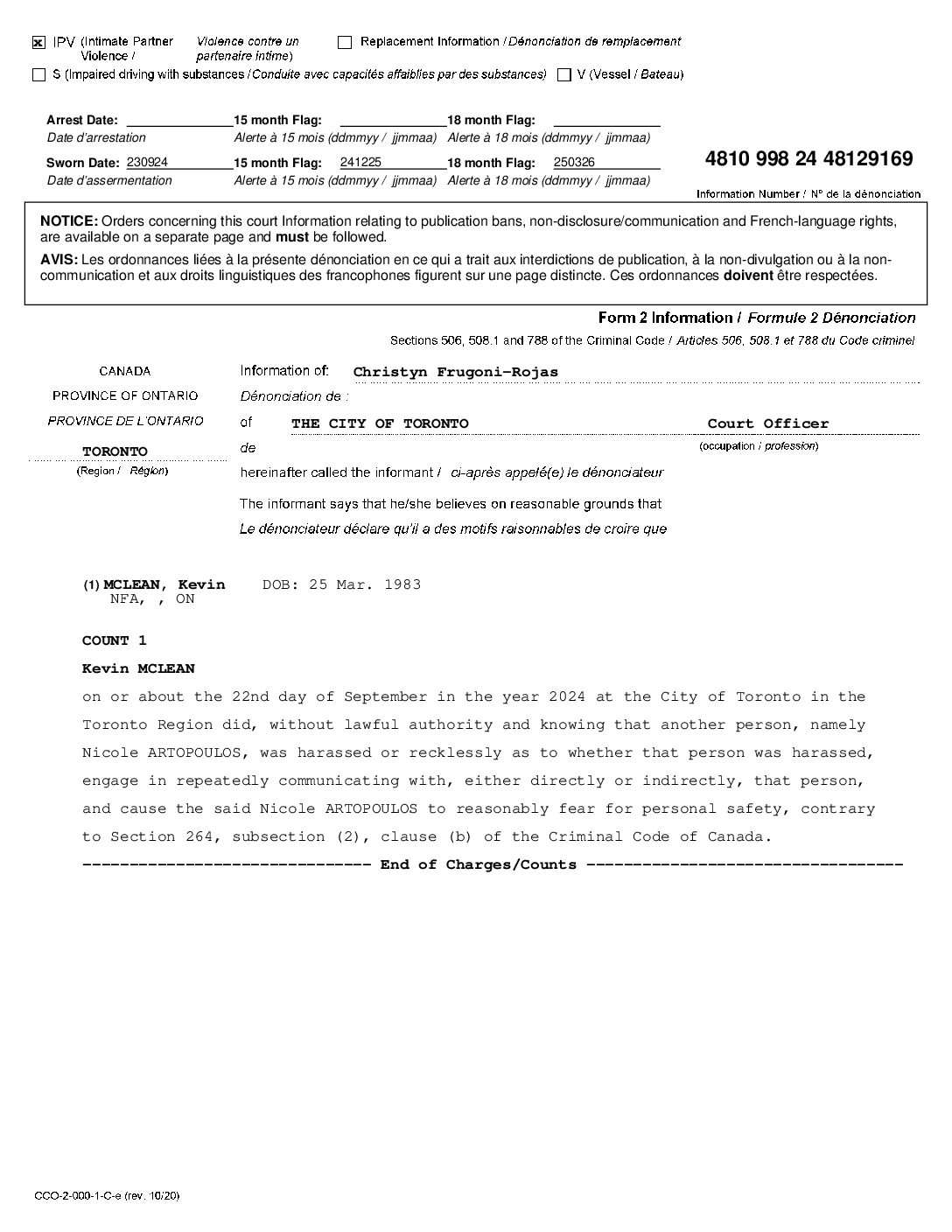
- Procedural Strategy: Despite physical hardship, Mr. McLean utilized an extensive command of procedural law during a multi-jurisdictional detention to secure his release by demanding adherence to Criminal Code protocols, specifically Form 2 and Form 7 requirements.
Litigation and Procedural Discovery
This commitment to legal redress led to the discovery of a notable event in Canadian legal history: the post-facto falsification of a six-page “Information Package” (footer CCO-2–000-1).
- Case Comparison: While historical precedents such as R. v. Silva (Quebec 2019/2020) involved the unauthorized use of a judicial stamp, the wholesale falsification of an entire six-page package is considered unprecedented.
- Ongoing Oversight: Further irregularities, nullities (jurisdictional in nature) discovered involving various levels of the judiciary remain subjects of scrutiny and formal complaint.
Outside Interests: Athletics and mental health (lifelong journeys – not destinations)
Mr. Kevin A. McLean (BA, JD, CIM) has always lived life at full speed — sometimes literally. He still holds the record for the fastest five‑kilometre time ever run by a lawyer in the Canadian Bar Association’s annual 5K race, clocking an extraordinary 15:05 in one of the years he won the event. Before entering law, Kevin competed on the Canadian National Tennis Team (U16 and U18), representing Canada at the world‑renowned Orange Bowl — the largest junior tennis tournament on the planet. Winning a round there placed him among the top 20 junior players globally in his age category.
His athletic career continued at The Ohio State University, where he played NCAA tennis on scholarship beginning in 2001. To this day, Kevin remains a proud Buckeye, a donor to the university, and a familiar (or intentionally hard‑to‑find) face on eight or so College Football Saturdays each year in Columbus, Ohio. He still enjoys the tradition of “Kegs and Eggs,” though for him it’s now just the eggs — Kevin is a long‑retired drinker who speaks openly and gratefully about the role evidence‑based treatment including medication for ADHD played in transforming his life. He recommends (but does not advise) anyone struggling with any such symptoms to seek professional help from a qualified psychiatrist.
Kevin is single, unmarried, and a non‑parent — not out of absence, but out of purpose. As he likes to say, he is “married to the game,” and he believes “the public deserves it.” His work, his advocacy, and his commitment to building accessible legal knowledge platforms reflect that ethos: disciplined, service‑oriented, and driven by a sense of responsibility larger than himself.
The Philosophy of LawCap
LawCap is a movement where intellectual application and mental fortitude are prioritized over brute force. The philosophy maintains that systemic corruption is addressed through analytical capacity and a command of the law. LawCap seeks the engagement of individuals dedicated to improving society and achieving accountability through truth. Live your life within the boundaries of law and on your own terms.
Contact Information and Helpful Links
Email: info@lawcap.ca and mclean@searchandseizure.ca
Confidential fax: (416) 352‑0055
Mailing address: Suite 314, 720 King Street West, Toronto, Ontario
Google My Business: LawCap Inc.
Feel free to check out our daily posts! We break the news before the so called “breaking news”! #breakthenewsbeforethebreakingnews (it is a mouthful but iron sharps iron and no pain no gain. If it was easy, everyone would be doing it. Feel free to chat with us on Google MyBusiness, email, text, call and if you are really fearful of government (and we have been there and nothing wrong with some out of an abundance of caution (ex abundanti cautela), you can confidentially fax at 1 (416) 352-0055). We honour strictly the duty of confidence found as precedent in the SCC and paying a little homage to No Limits Sportswear Inc. v. 0912139 B.C. Ltd., 2015 BCSC 1698 as per The Honourable Madam Justice S. Griffin (who in the Applicant’s estimation was and is a phenomenal judge but obviously he is most partial to The Honourable Madam Justice Gerow, The Honourable Mr. Justice Bowden, The Honourable Mr. Justice Grauer The Honourable Mr. Justice McIntosh, The Honourable Madam Justice Dickson, The Honourable Mr. Justice Masuhara, The Honourable Mr. Justice Goepel (as he then was) and The Honourable Mr. Justice Tysoe) (and oddly The Honourable Justice Matajawa as per the caselaw in LSBC v. Lawyer “A” as he found that the Applicant’s case against the LSBC involved him not consenting to any forensic copying (little did he or the Applicant know at the time that there was a Concealed RAM Dump).
Courage is contagious. A coward dies a thousands deaths but a warrior dies but one (Sir William Shakespeare). Lastly, to the extent that anything is shared via any medium, the recipient is under a strict duty of confidence and cannot be compelled to provide the same absent court order and to the extent any matter involves matters preparatory to litigation and/or ongoing litigation, it will be presumed to be protected by litigation privilege without any exceptions).
DISCLAIMER (generally)
It is strictly mandated that no constituent element of the information promulgated herein shall be erroneously construed as the provision of formal legal advisement; concurrently, the dissemination of such documentation ipso facto precludes the formation of any solicitor-client, attorney-client, or analogous professional relationship (the “Professional Relationship”). All articulated postulations, wherein they remain unanchored to demonstrable and objective empirical data, constitute the exclusive, prima facie perspectives of the underlying commercial enterprise (the “Commercial Enterprise”). Furthermore, all disseminated publications are incontrovertibly shielded by established jurisprudential defences (the “Jurisprudential Defences”), encompassing justification, fair comment promulgated strictly in good faith, and the rigorous execution of a moral, ethical, statutory, prescribed, and common law duty, coupled with recognized journalistic protections as elucidated by the Supreme Court of Canada in Grant v Torstar Corp, 2009 SCC 61 (the “Grant Decision”).
Potential Lawsuits (generally and this specific article, post or blog): Waiver of Personal Service and Cautionary Admonition
Regarding any subjective apprehension of a nascent cause of action within the jurisdiction of Ontario grounded in defamation, or any alternative tortious liability implicating this digital publication platform (the “Publication Platform”), the aforementioned commercial enterprise, or the individual proprietor, Kevin Alexander McLean, B.A., J.D., C.I.M. (the “Proprietor”, “CEO”, “Owner”, “Editor”)—who formerly practiced as a barrister and solicitor in the jurisdiction of British Columbia and maintains the professional designation of Chartered Investment Manager—it is unequivocally mandated that such grievances be addressed pursuant to the rigorous strictures of Canadian tort jurisprudence.
Should litigation be commenced against the commercial enterprise or the proprietor pertaining to allegations of defamation, irrespective of the underlying judiciousness of the antecedent legal advisement, service of process shall be accepted exclusively via electronic transmission at the previously designated electronic mailing addresses, thereby effectuating a binding waiver of the requirement for effectuating personal service. Notwithstanding this procedural concession, an unequivocal reservation of rights is maintained in limine for the explicit purpose of seeking security for costs, pursuing the summarily striking of the pleadings via summary judgment—strictly distinguished from a summary trial—and applying for elevated cost awards on a substantial indemnity or full indemnity basis against the initiating party in either a personal or corporate capacity. Furthermore, overarching rights are expressly reserved to seek interlocutory and injunctive relief, alongside the commencement of counterclaims seeking substantive damages for multifarious tortious infractions, expressly including the tort of abuse of process, and concurrently seeking remedial measures against any retained legal representatives. The prerogative to freely publish commentary delineating the procedural evolution of any such litigation, constituting public acta, is similarly and irrevocably reserved.
Given that causes of action sounding in defamation must be adjudicated before a superior court possessing inherent jurisdiction—specifically, a tribunal constituted pursuant to section 96 of the Constitution Act, 1867 (the “Section 96 Court”)—any party initiating such proceedings irrevocably attorns generally to the jurisdiction of the Province of Ontario and to that specific judicial echelon at first instance. Judicial resources remain intrinsically finite; their utilization necessitates the expenditure of the public treasury across multiple governmental strata. This encompasses the executive branch, financed by the provincial government via the taxation of the citizenry; the judicial branch, remunerated by the federal government; and tertiary municipal expenditures whereby auxiliary judicial officers are perpetually contracted through municipal law enforcement agencies, functioning effectively as a government institution (the “Government Institution”), such as the Toronto Police Services Board.
While the fundamental right to articulate dissenting opinions is rigorously respected, and electronic correspondence remains welcomed for the exclusive purpose of identifying substantive inaccuracies necessitating amelioration, it is unambiguously declared that no financial indemnification shall be disbursed, as no valid cause of action in defamation or otherwise is recognized to subsist. Consequently, should the instigation of formal litigation remain the finalized trajectory, the requisite tariff of fees must be remitted in strict accordance with the attendant regulations promulgated under the Administration of Justice Act, R.S.O. 1990, c. A.4. Subsequently, discrete copies of the formally issued—as rigidly distinguished from merely filed—statement of claim (the “Statement Of Claim”) must be concurrently served upon all respective respondents, whereupon subsequent procedural mechanisms shall be accordingly activated. Any deviation from these prescribed procedural modalities, constituting a direct contravention of statutory mandates, the equitable doctrines of fairness, or the strictures delineated within the Rules of Civil Procedure, R.R.O. 1990, Reg. 194 (the “Procedural Rules”), shall categorically not be countenanced as a remediable irregularity. Rather, such defective origination or procedural non-compliance shall be definitively construed as an absolute nullity, functioning ultra vires the initiating party’s jurisprudential authority, and effectuating a compulsory reversion to the status quo ante.
Love Finding Topics in an Efficient Manner?
Do you need any help finding a topic or tag, in addition to our encyclopedia, please click our “Legal Topics & Investigative Index” and it will assist in you finding topics, posts, blogs, and pages on that specific topic or tag: https://lawcap.ca/legal-topics-investigative-index/
Feel free to check out “No Cap” © Legal Encyclopedia ©, which is updated and grows daily: https://lawcap.ca/law-cap-inc-s-proprietary-and-trademarked-no-cap-legal-encyclopedia/#jn-a
Are you looking for more high level educational information in a If you’re revisiting material from the previous Division and need fast access, Law Cap Inc. has organized hyperlinks to each topic for seamless retrieval.
5.1.1. A
5.1.1. A (I): Advanced Forensic Imaging – Bit‑Level Authenticity
5.1.1. A (II): Bit‑Level Authenticity — Automated Metadata Extraction & Integrity Verification
5.1.1. A (III): Algorithmic Evidence Parsing – Digital Chain‑of‑Custody
5.1.2. B
5.1.2. B (I): Binary‑Level Evidence Reconstruction
5.1.2. B (II): Blockchain‑Anchored Evidence Preservation
5.1.2. B
5.1.3. C
5.1.3. C (II): Cryptographic Hash Validation – Authenticity Assurance
5.1.3. C (III): CPU‑Level Memory Extraction – Volatile Evidence Capture
5.1.4. D
5.1.4. D (II): Disk Imaging Protocols – Forensic Standards
5.1.4. D (III): Data Integrity Failures – Evidentiary Collapse
5.1.5. E
5.1.5. E (I): Encrypted Evidence Handling – Key Management Protocols
5.1.5. E (II): Evidence Tampering Detection – OCR & Typography Analysis
5.1.5. E (III): External Drive Seizure – Chain of Custody Requirements
5.1.6. F
5.1.6. F (I): Forensic Copying – Essential Guide
5.1.6. F (II): Forensic Copying vs RAM Captures
5.1.6. F (III): Fileless Backdoors & WMI Persistence – Surveillance Detection
5.1.6. F (IV): Forensic Metadata Reconstruction – Authenticity Restoration
5.1.7. G
5.1.7. G (I): GPU Memory Dumps – Hidden Evidence Extraction
5.1.7. G (II): Garbled OCR Court Records – Authenticity Analysis
5.1.8. H
5.1.8. H (I): Hex Level Evidence Review – Raw Data Integrity
5.1.8. H (II): Metadata Poisoning – Intentional Metadata Corruption
5.1.9. I
5.1.9. I (I): Image‑Based Evidence – Pixel‑Level Authenticity Review
5.1.9. I (II): Image‑Based Evidence – Pixel‑Level Manipulation Detection
5.1.9. I (III): Image‑Based Evidence – Pixel‑Level Authenticity Reconstruction
5.1.10. J
5.1.10. J (I): JPEG Compression Artifacts – Authenticity Indicators
5.1.10. J (II): JPEG Double‑Compression – Manipulation Detection
5.1.10. J (III): JPEG Quantization Tables – Authenticity Verification
5.1.11. K
5.1.11. K (I): Kerning Irregularities – Typography‑Based Forgery Detection
5.1.11. K (II): Typography Drift – PDF Forgery & Document Tampering Detection
5.1.11. K (III): Typography Layer Overwrites – Digital Document Tampering
5.1.12. L
5.1.12. L (I): Layer‑Sequence Reconstruction – Hidden Edit Identification
5.1.12. L (II): Layer‑Stack Integrity – PDF & Hybrid Document Authenticity
5.1.12. L (III): Layer‑Blend Anomalies – Digital Forgery & Hidden Edit Detection
5.1.13. M
5.1.13. M (I): Metadata‑to‑Pixel Correlation – Cross‑Layer Authenticity Verification
5.1.13. M (II): Metadata‑Chain Reconstruction – Authenticity Restoration
5.1.13. M (III): Metadata‑Origin Verification – Device & Source Authenticity
5.1.14. N
5.1.14. N (I): Noise‑Pattern Integrity – Sensor & Rendering Authenticity
5.1.14. N (II): Noise‑Pattern Discontinuities – Hidden Edit & Region‑Level Tampering
5.1.14. N (III): Noise‑Pattern Fabrication – Synthetic & Software‑Generated Artifacts
5.1.15. O
5.1.15. O (I): Optical‑Flow Irregularities – Motion‑Based Manipulation Detection
5.1.15. O (II): Temporal‑Interpolation Artifacts – AI & Software‑Generated Frame Synthesis
5.1.15. O (III): Temporal‑Cadence Breaks – Frame‑Timing Authenticity Verification
5.1.16. P
5.1.16. P (I): Pixel‑Level Authenticity Review – Raw Image Integrity
5.1.16. P (II): Pixel‑Adjacency Irregularities – Splicing & Region‑Level Manipulation
5.1.16. P (III): Pixel‑Gradient Anomalies – Microscopic Edit & Region‑Boundary Detection
5.1.17. Q
5.1.17. Q (I): Quantization‑Table Integrity – Compression‑Signature Authenticity
5.1.17. Q (II): Quantization‑Table Anomalies – Recompression & Manipulation Detection
5.1.17. Q (III): Quantization‑Residual Mapping – Compression‑Artifact Differential Analysis
5.1.18. R
5.1.18. R (I): Raster‑Vector Inconsistencies – Hybrid Forgery Detection
5.1.18. R (II): Raster‑Layer Artifact Mapping – Pixel‑Structure Tampering Detection
5.1.18. R (III): Raster‑Vector Boundary Differential – Cross‑Layer Tampering Detection
5.1.19. S
5.1.19. S (II): Screenshot‑Compression Signatures – Platform & Pipeline Verification
5.1.19. S (III): Screenshot‑UI Rendering Drift – Platform‑Native Interface Authenticity
5.1.20. T
5.1.20. T (I): Typography Drift – Font & Glyph Rendering Inconsistencies
5.1.20. T (II): Font‑Embedding Irregularities – PDF & Document Forgery Indicators
5.1.21. U
5.1.21. U (I): UI‑Layer Authenticity – Interface Element Integrity Verification
5.1.21. U (II): UI‑Element Residual Mapping – Microscopic Interface Tampering Detection
5.1.22. V
5.1.22. V (I): Vector‑Layer Authenticity – Native Glyph & Shape Integrity Verification
5.1.22. V (II): Vector‑Raster Hybrid Detection – Structural Inconsistencies Across Layer Types
5.1.22. V (III): Vector‑Boundary Differential – Microscopic Outline & Edge Integrity Analysis
5.1.23. W
5.1.23. W (I): Workflow‑Origin Verification – Native Pipeline Authenticity Analysis
5.1.23. W (II): Workflow‑Anomaly Drift – Cross‑Stage Pipeline Manipulation Detection
5.1.23. W (III): Workflow‑Boundary Differential – Cross‑Stage Structural Integrity Detection
5.1.24. X
5.1.24. X (I): Cross‑Layer Authenticity – Multi‑Modal Structural Integrity Verification
5.1.24. X (II): Cross‑Layer Drift – Multi‑Modal Rendering & Structural Inconsistency Detection
5.1.23. Y
5.1.23. Y (I): YARA Rule‑Based Evidence Detection
5.1.23. Y (II): Yield‑Based Digital Evidence Classification
5.1.24. Z
5.1.24. Z (I): Zero‑Day Exploit Tracing – Forensic Attribution
5.1.24. Z (II): Zero‑Knowledge Proofs – Evidence Integrity Applications
For rapid access to additional topics within this Division, Law Cap Inc. offers structured hyperlinks to each entry for efficient review and analysis.
6.1.1. A (I): Algorithmic Obfuscation in Securities Fraud 6.1.1. A (II): Automated Market Makers – Constant Product Manipulation 6.1.1. A (III): Algorithmic Distribution & Sybil Architecture in Unregistered Offerings 6.1.2. B (I): Beacon Chain Committees – Collusion & Proof-of-Stake Fraud 6.1.3. C (I): Compiling EVM Bytecode – Prosecuting Algorithmic Obfuscation 6.1.3. C (II): Cross-Chain Asset Expropriation – Seized Cryptographic Keys 6.1.3. C (III): Cryptographic Consensus – Adjudicating Market Integrity 6.1.3. C (IV): Custodial Dominion – Digital Asset Control Failures 6.1.4. D (I): Decentralized Applications – Unregistered Token Swapping 6.1.4. D (II): Digital Signatures – Evidentiary Supremacy & Spoliation Eradication 6.1.4. D (III): Distributed Key Infrastructure – Multi-Party Control & Failure Cascades 6.1.4. D (IV): Digital Asset Custody – Multi-Chain Insolvency & Reserve Vaporization 6.1.5. E (I): Ethereum – Securities Fraud & Market-Integrity Violations 6.1.5. E (II): Ethereum – Smart-Contract Governance Manipulation 6.1.5. E (III): Ethereum – MEV Extraction & Market Abuse 6.1.5. E (IV): Ethereum – Layer-2 Rollups & Fraud-Proof Manipulation 6.1.6. F (I): Fraudulent Tokenomics – Engineered Economic Misrepresentation 6.1.6. F (II): Fraudulent Tokenomics – Synthetic Scarcity & Supply-Curve Manipulation 6.1.6. F (III): Fraudulent Tokenomics – Circular Incentive Loops & Ponzi-Like Reward Structures 6.1.6. F (IV): Fraudulent Tokenomics – Liquidity-Trap Mechanisms & Exit-Suppression Architecture 6.1.7. G (I): Governance Fraud – Concentrated Control & Pseudonymous Power Structures 6.1.7. G (II): Governance Fraud – Proposal Engineering & Hidden-Function Activation 6.1.7. G (III): Governance Fraud – Vote-Buying, Flash-Loan Voting & Synthetic Participation 6.1.7. G (IV): Governance Fraud – Delegation Abuse & Governance-Token Centralization 6.1.8. H (I): Hybrid Fraud Structures – Multi-Layered Digital-Asset Deception 6.1.8. H (II): Hybrid Fraud Structures – Cross-Chain Liquidity Masking & Synthetic Depth Fabrication 6.1.8. H (III): Hybrid Fraud Structures – Multi-Protocol Collusion & Coordinated Ecosystem Manipulation 6.1.8. H (IV): Hybrid Fraud Structures – Ecosystem-Wide Synthetic Stability & Coordinated Market Illusion 6.1.9. I (I): Insider Fraud – Privileged Access Exploitation & Hidden Control Pathways 6.1.9. I (II): Insider Fraud – Multisig Collusion, Key Compromise & Coordinated Privilege Abuse 6.1.9. I (III): Insider Fraud – Oracle Manipulation, Validator Collusion & Consensus-Layer Exploitation 6.1.9. I (IV): Insider Fraud – Custodial Misrepresentation, Reserve Fabrication & Hidden Insolvency 6.1.10. J (I): Market-Wide Fraud – Coordinated Manipulation Across Exchanges, Protocols & Liquidity Networks 6.1.10. J (II): Market-Wide Fraud – Cross-Exchange Spoofing, Layered Orders & Synthetic Volatility Cycles 6.1.10. J (III): Market-Wide Fraud – Derivatives Manipulation, Liquidation Engineering & Funding-Rate Distortion 6.1.10. J (IV): Market-Wide Fraud – Global Liquidity Shock Engineering & Coordinated Cross-Asset Collapse 6.1.11. K (I): Cross-Jurisdictional Fraud – Regulatory Arbitrage, Offshore Structuring & Multi-Region Evasion 6.1.11. K (II): Cross-Jurisdictional Fraud – Shell Networks, Nominee Directors & Multi-Layer Corporate Obfuscation 6.1.11. K (III): Cross-Jurisdictional Fraud – AML Arbitrage, Identity Laundering & Regulatory-Perimeter Evasion 6.1.11. K (IV): Cross-Border Laundering Networks, Bridge-Based Evasion & Multi-Chain Disguise Systems 6.1.12. L (I): Governance Fraud – Delegation Capture, Vote-Weight Manipulation & Protocol-Control Subversion 6.1.12. L (II): Governance Fraud – Proposal Manipulation, Agenda-Stacking & Procedural Capture 6.1.12. L (III): Governance Fraud – Treasury-Seizure Governance, Budgetary Manipulation & Controlled Resource Allocation 6.1.12. L (IV): Governance Fraud – Upgrade-Pathway Capture, Protocol-Rewrite Authority & Hidden Governance Backdoors 6.1.13. M (I): Oracle Fraud – Price-Feed Distortion, Data-Source Corruption & Synthetic Market Signals 6.1.13. M (II): Oracle Fraud – Time-Weighted Average Price (TWAP) Manipulation, Latency Exploits & Feed-Timing Attacks 6.1.13. M (III): Oracle Fraud – Multi-Source Aggregation Manipulation, Weighted-Feed Distortion & Cross-Oracle Collusion 6.1.14. N (I): Collateral Fraud – Reserve Fabrication, Over-Collateralization Illusions & Synthetic Backing Structures 6.1.14. N (II): Collateral Fraud – Cross-Chain Reserve Fragmentation, Wrapped-Asset Insolvency & Custodial-Layer Deception 6.1.14. N (III): Collateral Fraud – Illiquid Collateral, Correlated-Asset Backing & Hidden Leverage Structures 6.1.14. N (IV): Collateral Fraud – Redemption-Pathway Obstruction, Withdrawal-Delay Engineering & Insolvency Concealment 6.1.15. O (II): Liquidity Fraud – Cross-Venue Liquidity Mirroring, Synthetic Routing & Multi-Exchange Depth Fabrication 6.1.15. O (III): Liquidity Fraud – Insider-Controlled Market-Maker Networks, Liquidity-Withdrawal Shock Events & Coordinated Depth Collapses 6.1.15. O (IV): Liquidity Fraud – Cross-Chain Liquidity Teleportation, Bridge-Layer Depth Illusions & Multi-Hop Liquidity Disguise Systems 6.1.16. P (I): Market-Structure Fraud – Order-Book Sculpting, Execution-Path Manipulation & Synthetic Volatility Engineering 6.1.16. P (II): Market-Structure Fraud – Cross-Venue Latency Gaming, Sequencer Manipulation & Priority-Path Exploitation 6.1.16. P (III): Market-Structure Fraud – MEV Cartelization, Backrun-Harvesting Networks & Transaction-Flow Capture 6.1.16. P (IV): Market-Structure Fraud – Private Mempool Corruption, Shadow-Orderflow Markets & Dark-Route Execution Systems 6.1.17. Q (I): Governance Fraud – Vote-Weight Manipulation, Delegation-Capture Schemes & Protocol-Control Subversion 6.1.17. Q (II): Governance Fraud – Proposal-Stacking, Agenda-Flooding & Procedural-Manipulation Attacks 6.1.17. Q (III): Governance Fraud – Delegate-Bribery Markets, Influence-Purchase Networks & Governance-Vote Monetization 6.1.17. Q (IV): Governance Fraud – Governance-By-Ambush, Emergency-Vote Exploitation & Crisis-Narrative Manipulation 6.1.18. R (I): Treasury Fraud – Treasury-Drain Architectures, Multi-Sig Capture & Budget-Allocation Deception 6.1.18. R (II): Treasury Fraud – Grant-Program Corruption, Ecosystem-Fund Misappropriation & Development-Budget Laundering 6.1.18. R (III): Treasury Fraud – Treasury-Swap Manipulation, Asset-Conversion Abuse & Reserve-Reallocation Schemes 6.1.18. R (IV): Treasury Fraud – Reserve-Backdoor Engineering, Collateral-Shadowing & Hidden-Liability Creation 6.1.19. S (I): Oracle Fraud – Price-Feed Distortion, Data-Path Corruption & Multi-Source Manipulation 6.1.19. S (II): Oracle Fraud – Time-Weighted Manipulation, Update-Window Exploitation & Latency-Driven Price Attacks 6.1.19. S (III): Oracle Fraud – Cross-Chain Oracle Desynchronization, Bridge-Feed Spoofing & Synthetic-Route Data Injection 6.1.19. S (IV): Oracle Fraud – Validator-Collusion Feeds, Committee-Capture Manipulation & Oracle-Governance Subversion 6.1.20. T (I): Liquidity Fraud – Liquidity-Pool Entrapment, Depth-Illusion Engineering & Withdrawal-Path Obstruction 6.1.20. T (II): Liquidity Fraud – Liquidity-Mirroring Networks, Phantom-Depth Synchronization & Multi-Venue Drain Cycles 6.1.20. T (III): Liquidity Fraud – Liquidity-Vacuum Events, Shock-Drain Engineering & Volatility-Harvest Mechanisms 6.1.20. T (IV): Liquidity Fraud – Liquidity-Rehypothecation Loops, Synthetic-Depth Leverage & Recursive-Pool Exploitation 6.1.21. U (I): Collateral Fraud – Collateral-Substitution Schemes, Backing-Obfuscation & Synthetic-Collateral Fabrication 6.1.21. U (II): Collateral Fraud – Collateral-Recycling Loops, Multi-Layer Backing Pyramids & Cross-Asset Collateral Reuse 6.1.21. U (III): Collateral Fraud – Collateral-Shadow Markets, Off-Chain Reserve Arbitrage & Hidden-Encumbrance Networks 6.1.21. U (IV): Collateral Fraud – Collateral-Drain Triggers, Redemption-Run Engineering & Backing-Collapse Orchestration 6.1.22. V (I): Redemption Fraud – Redemption-Path Manipulation, Exit-Window Corruption & Priority-Queue Exploitation 6.1.22. V (II): Redemption Fraud – Multi-Tier Redemption Hierarchies, Insider-First Liquidity Allocation & Redemption-Order Distortion 6.1.22. V (III): Redemption Fraud – Redemption-Liquidity Withholding, Partial-Fill Manipulation & Slippage-Amplification Extraction 6.1.22. V (IV): Redemption Fraud – Redemption-Backdoor Channels, Insider-Only Escape Routes & Hidden-Priority Withdrawal Mechanisms 6.1.23. W (I): Withdrawal Fraud – Withdrawal-Path Sabotage, Exit-Liquidity Diversion & Multi-Route Withdrawal Manipulation 6.1.23. W (II): Withdrawal Fraud – Withdrawal-Queue Corruption, Sequencer-Ordered Exit Manipulation & Timestamp-Distortion Withdrawal Priority 6.1.23. W (III): Withdrawal Fraud – Withdrawal-Liquidity Partitioning, Route-Segmentation Deception & Fragmented-Exit Liquidity Traps 6.1.23. W (IV): Withdrawal Fraud – Withdrawal-Failure Orchestration, Synthetic-Outage Engineering & Exit-Layer Collapse Design 6.1.24. X (I): Oracle Fraud – Oracle-Feed Distortion, Data-Path Corruption & Price-Signal Manipulation 6.1.24. X (II): Oracle Fraud – Oracle-Latency Exploitation, Stale-Data Arbitrage & Update-Cycle Manipulation 6.1.24. X (III): Oracle Fraud – Multi-Source Oracle Collusion, Cross-Oracle Price-Sync Manipulation & Aggregator-Layer Distortion 6.1.25. Y (I): Sequencer Fraud – Sequencer-Level Transaction Reordering, Private-Mempool Manipulation & Block-Construction Exploitation 6.1.25. Y (II): Sequencer Fraud – Sequencer-Governance Capture, Proposer-Builder Collusion & Sequencer-Rotation Manipulation 6.1.25. Y (III): Sequencer Fraud – Sequencer-Censorship Attacks, Transaction-Inclusion Suppression & Selective-Execution Manipulation 6.1.25. Y (IV): Sequencer Fraud – Cross-Chain Sequencer Manipulation, Bridge-Sync Interference & Multi-Domain Execution Distortion 6.1.26. Z (I): Validator Fraud – Validator-Set Collusion, Committee-Rotation Manipulation & Consensus-Layer Extraction 6.1.26. Z (II): Validator Fraud – Validator-Key Compromise, Attestation-Forgery Schemes & Signature-Set Manipulation 6.1.26. Z (III): Validator Fraud – Validator-Censorship Operations, Block-Proposal Suppression & Finality-Delay Manipulation 6.1.26. Z (IV): Validator Fraud – Validator-Reorg Engineering, Fork-Choice Distortion & Short-Range Chain-Rewrite Manipulation 6.1.27 (I): Cross-System Market Manipulation – Multi-Chain Securities Fraud 6.1.28 (I): Failure of Custodial Platforms – Digital Asset Custodial Insolvency & Securities Exposure 6.1.29 (I): Phantom Liquidity Events – Illusory Market Depth & Fraudulent Liquidity Signaling 6.1.31 (I): Digital Asset Spoliation – Intentional Destruction of On-Chain Evidence & Transaction-History Manipulation 6.1.32 (I): Smart Contract Negligence – Immutable Code Failures & Fiduciary Duty Breach 6.1.33 (I): Cross-Jurisdictional AML Evasion – Layered Digital Laundering & Regulatory Arbitrage 6.1.34 (I): Digital Securities Phantomization – Nonexistent Token Supply & Fraudulent Issuance 6.1.35 (I): Market Integrity Collapse – Systemic Digital Asset Manipulation & Structural Market Failure 6.1.36 (I): Crypto-Regulatory Arbitrage – Exploiting Multi-National Enforcement Gaps & Jurisdictional Fragmentation 6.1.37 (I): Digital Custody Misrepresentation – False Claims of Asset Control & Custodial-Layer Deception 6.1.38 (I): Blockchain Evidence Tampering – On-Chain Manipulation of Transaction History & Forensic Obstruction 7. Law Cap Inc.’s Proprietary and Trademarked “No Cap Legal Encyclopedia”
Ready to continue your deep dive? Law Cap Inc. has curated direct hyperlinks to the next Division for seamless navigation and expanded insight.
7.1. Administrative Law & Judicial Review – Encyclopedia Index
- 7.1.42 (I): Administrative Decision Phantomization – Orders Issued Without Jurisdiction
- 7.1.41 (I): Administrative Evidence Vitiation – Manipulated or Missing Records
- 7.1.40 (I): Procedural Justice Collapse – Failure of Natural Justice
- 7.1.39 (I): Administrative Nullification Events – When Decisions Lose Legal Force
- 7.1.38 (I): Judicial Review Integrity – Standards for Proper Administrative Oversight
- 7.1.37 (I): Administrative Collapse Doctrine – Systemic Failure of Decision Making
- 7.1.36 (I): Tribunal Misconduct – Improper Conduct by Decision Makers
- 7.1.35 (I): Administrative Nullity Thresholds – Triggers for Decision Invalidity
- 7.1.34 (I): Administrative Overreach – Exceeding Statutory Mandate
- 7.1.33 (I): Administrative Evidence Collapse – Record Integrity Failure
- 7.1.32 (I): Procedural Fairness Collapse – Failure to Provide Meaningful Participation
- 7.1.31 (I): Judicial Review Nullity Doctrine – When Administrative Decisions Become Legally Nonexistent
- 7.1.30 (I): Administrative Authority Collapse – Loss of Jurisdictional Legitimacy
- 7.1.29 (I): Administrative Misclassification – Improper Categorization of Applications
- 7.1.28 (I): Procedural Collapse Events – Systemic Fairness Failure
- 7.1.27 (I): Administrative Phantom Decisions – Nonexistent Orders
- 7.1.26 (I): Multi Layer Administrative Failure – System Wide Procedural Breakdown
- 7.1.3 C (XXIX): Remedies for Administrative Improper Delegation of Legislative Power – Preventing Unauthorized Law Making by Public Bodies
- 7.1.3 C (XXVIII): Remedies for Administrative Subdelegation – Preventing Unauthorized Transfer of Statutory Power
- 7.1.3 C (XXVII): Remedies for Administrative Acting Under Dictation – Protecting Independent Decision Making
- 7.1.3 C (XXVI): Remedies for Administrative Jurisdictional Error – Enforcing the Boundaries of Statutory Power
- 7.1.3 C (XXIV): Remedies for Administrative Legitimate Expectations – Enforcing Predictability and Fair Reliance
- 7.1.3 C (XXII): Remedies for Administrative Abuse of Discretion – Constraining Excessive, Arbitrary, or Unprincipled Power
- 7.1.3 C (XXI): Remedies for Administrative Procedural Unfairness – Enforcing the Duty of Fairness
- 7.1.3 C (XX): Remedies for Administrative Unreasonableness – Enforcing Rational, Statutory, and Evidence Based Decision Making
- 7.1.3 C (XIX): Remedies for Administrative Failure to Consider Relevant Factors – Enforcing Statutory Decision Making Duties
- 7.1.3 C (XVIII): Remedies for Administrative Irrelevant Considerations – Ensuring Decisions Rest on Lawful Grounds
- 7.1.3 C (XVII): Remedies for Administrative Fettering – Restoring Genuine Exercise of Discretion
- 7.1.3 C (XVI): Remedies for Administrative Improper Purpose – Preventing Abuse of Statutory Mandates
- 7.1.3 C (XV): Remedies for Administrative Bad Faith – Judicial Response to Abuse of Public Power
- 7.1.3 C (XIV): Remedies for Administrative Bias – Restoring Impartial Decision Making
- 7.1.3 C (XII): Structural Remedies – Correcting Systemic Administrative Unfairness
- 7.1.3 C (X): Judicial Review Stays – Suspending Administrative Enforcement Pending Court Oversight
- 7.1.3 C (VIII): Damages – Compensation for Administrative Wrongdoing
- 7.1.3 C (VII): Habeas Corpus – Restraining Unlawful Administrative Detention
- 7.1.3 C (VI): Injunctions – Preventing Irreparable Administrative Harm
- 7.1.3 C (V): Declaratory Relief – Judicial Clarification of Administrative Legality
- 7.1.3 C (IV): Prohibition – Preventing Unlawful Administrative Action
- 7.1.3 C (III): Mandamus – Compelling Administrative Action
- 7.1.3 C (II): Contempt by Registry Staff – Judicial Review Obstruction
- 7.1.3 C (I): Certiorari – Quashing Unlawful Administrative Decisions
- 7.1.2 B (III): Constitutional Constraints on Administrative Bodies
- 7.1.2 B (I): Bias in Administrative Decision Making – Natural Justice Nullity
- 7.1.1 A (III): Administrative Delay – Jurisdictional Defect
- 7.1.1 A (II): Administrative Attrition – Systemic Decision Making Collapse
- 7.1.1 A (I): Administrative Fairness & Mandatory Consideration Doctrine